Best Time for Gorilla Trekking: Month-by-Month Guide
· FaunaExplore

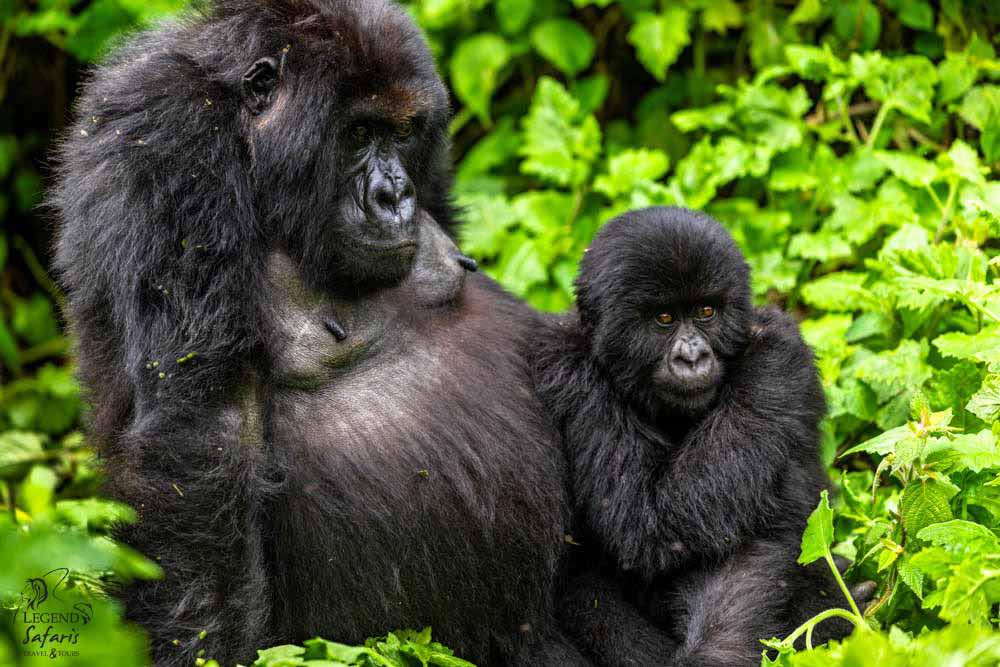
Photo: Legend Safaris
The best time for gorilla trekking in Rwanda and Uganda is during the two dry seasons: June to September and December to February. During these months, trails are firmer, rain is less frequent and photography conditions are more reliable.
Gorilla trekking runs all year in both countries, though. The rainy months (March to May and October to November) bring muddier, harder hikes but also lusher forest, fewer visitors and easier access to permits.
Gorillas don't migrate, so you have roughly the same chance of seeing them in any month. What changes is how hard the trek is, how crowded the lodges are and how quickly permits sell out. This guide covers each season, gives a month-by-month breakdown and explains when to book your gorilla permits.
How the seasons work in gorilla country
Rwanda's Volcanoes National Park and Uganda's Bwindi Impenetrable National Park and Mgahinga Gorilla National Park all sit close to the equator, at altitudes of roughly 1,160 to 4,500 metres. That gives them two dry seasons and two wet seasons a year rather than a summer and a winter. Temperatures stay fairly steady year-round: mornings are cool, and afternoons are mild.
One thing to keep in mind is that these are montane rainforests. This means a shower is possible on any day, even in the middle of the dry season, so pack a waterproof jacket whatever month you travel.
For a complete introduction to planning your trip, see our complete gorilla trekking guide.

Gorilla trekking in the dry season (June–September and December–February)
The dry season is peak season for good reason:
- Easier trails. Slopes are less slippery, so treks tend to be faster and less tiring, which matters when a hike can last anywhere from one hour to six or more.
- Better photography. Less rain and less mist usually mean clearer light under the canopy.
- Easier add-ons. Dry roads make it simpler to combine gorillas with chimpanzee trekking or a savannah safari.
However, the trade-off is demand. June to September is the busiest period in both countries, and the December to February window fills up around the Christmas and New Year holidays. Permits and the best lodges often sell out months ahead.
Gorilla trekking in the rainy season (March–May and October–November)
But don't rule out the wet months, as trekking in the rainy season has real advantages:
- Permit availability. It is far easier to get permits for your preferred dates and gorilla sectors.
- Fewer people. Lodges are quieter, and some offer lower rates.
- Lush scenery. The forest is at its greenest, and gorillas may stay on lower slopes where food is plentiful, which can sometimes mean a shorter walk.
In this period, expect muddy, steep, slippery trails and the possibility of heavy downpours. Rain usually falls in bursts rather than all day, so many treks go ahead in dry spells. Good waterproof boots, gaiters, gardening gloves and a porter make a big difference. April and May are generally the wettest months.
Month-by-month guide to gorilla trekking
| Month | Season | Trail conditions | Demand for permits | Verdict |
|---|---|---|---|---|
| January | Short dry season | Mostly dry, firm trails | High | Excellent |
| February | Short dry season | Dry, good visibility | High | Excellent |
| March | Long rains begin | Increasingly muddy | Moderate | Good for flexible travellers |
| April | Long rains (wettest) | Very muddy, slippery | Low | Budget and availability pick |
| May | Long rains | Muddy, lush forest | Low | Quiet, green, fewer crowds |
| June | Long dry season | Dry, easier hiking | Very high | Excellent (book early) |
| July | Long dry season | Dry, firm trails | Very high | Peak season |
| August | Long dry season | Dry, firm trails | Very high | Peak season |
| September | Dry, turning wetter | Mostly dry | High | Very good |
| October | Short rains | Muddy in places | Moderate | Good value |
| November | Short rains | Muddy, green | Low to moderate | Quiet, good availability |
| December | Short dry season | Drying out | High (holidays) | Excellent (book early) |
Keep in mind that rainfall patterns vary from year to year and between parks, so treat this table as a guide rather than a guarantee for the best time for gorilla trekking.
Rwanda vs Uganda: does timing differ?
The seasonal pattern is broadly the same in both countries, so the table above applies to each. The bigger differences are cost, access and how quickly permits sell out.
- Rwanda (Volcanoes National Park) is about a two-and-a-half-hour drive from Kigali, which makes it ideal for short trips. Trails climb the slopes of the Virunga volcanoes, and the terrain is often steep but more open than in Bwindi. For more information, see our Rwanda wildlife tours.
- Uganda (Bwindi and Mgahinga) has around half of the world's mountain gorillas and more habituated gorilla families to choose from. Bwindi's dense, steep forest can be especially tough after rain, so fitness and footwear matter more in the wet months. Explore our Uganda wildlife tours.
Gorilla permit prices and the low-season discount
- At the time of writing, a Rwanda gorilla permit costs USD 1,500 per person. Some reports suggest this may rise towards USD 1,800 under a new tariff.
- By comparison, Uganda's standard gorilla permit costs USD 800 per person for foreign non-residents.
The Uganda Wildlife Authority (UWA) has offered discounted gorilla permits during low-season months in the past, but there is no guarantee a discount will apply in 2027. If budget is a deciding factor, ask your tour operator to confirm the permit price for your exact dates before you pay a deposit. That way you're paying the rate that actually applies, not one quoted in an old blog post.
Even without a permit discount, travelling in the rainy season can lower your overall trip cost through reduced lodge rates and better availability at mid-range properties.

When to book gorilla permits
Each habituated gorilla family can be visited by only a small group of trekkers (usually a maximum of eight) once a day, so permits are limited. As a rule:
- Peak months (June–September, December–February): book at least 3–6 months ahead. For July, August and the holiday period, 6 months or more is safer, especially if you want a particular lodge or, in Uganda, a particular Bwindi sector.
- Shoulder and rainy months: 1–3 months is often enough, although earlier booking still gives you more choice.
- Combined itineraries (gorillas plus chimpanzees or a savannah safari) need extra lead time, because every permit and lodge has to line up on consecutive days.
Booking through a trusted tour operator is usually the simplest option. The operator secures the permit, coordinates transfers and builds the trek into a full itinerary. Browse our gorilla trekking tours to compare options.
If you’re considering booking a gorilla trekking tour, take a look at our featured tours:
- 9-Day Rwanda Primate Safari: Gorilla & Chimpanzee Trekking: A luxury primate itinerary combining mountain gorillas in Volcanoes National Park with chimpanzee trekking. Starts from USD 9,500 per person. View tour.
- 11-Day Uganda Safari: Gorillas, Chimpanzees & Wildlife Adventure: A mid-range adventure pairing gorilla trekking in Bwindi with chimpanzees and classic Ugandan wildlife. Starts from USD 4,100 per person. View tour.
So, what’s the best time for gorilla trekking?
- For the easiest trekking and the most reliable weather: June to September, or December to February. Book 3–6 months ahead at a minimum.
- For availability, fewer crowds and possible savings: March to May, or October to November. Be ready for mud.
- For a balance of the two: early June, late September or January usually offer good conditions with slightly less pressure on permits than peak weeks.
Whichever month you choose, the moment you meet a gorilla family face to face is what the trip is about, and it is just as powerful in the rain as in the sun. When you're ready to plan, head back to our complete gorilla trekking guide or compare gorilla trekking tours from our verified operators.