
Churchill Polar Bear Tours: Best Time, Cost & What to Expect
· FaunaExplore

Photo: Frontiers North Adventures
If you want to see wild polar bears from land, book one of the Churchill polar bear tours that run between mid-October and mid-November. Churchill is the most reliable place on Earth to watch them in the wild, because dozens of bears gather on the Hudson Bay coast at the same time every autumn, waiting for the sea to freeze.
The catch is the calendar. The season lasts roughly six weeks, the best lodges hold only a few dozen guests, and the prime dates sell out a year or more ahead. As we write this in mid-October, the bears are arriving on the coast and most of this season's departures are already full. If Churchill polar bear tours are on your list, now is the moment to plan for next autumn.
This guide covers when to go week by week, how Tundra Buggy day trips compare with staying at the Tundra Buggy Lodge, what it really costs, and what a day on the tundra looks like.
Why Churchill? The freeze-up gathering, explained
Polar bears are marine mammals. They hunt seals from the sea ice, and almost everything they eat is caught there. Hudson Bay is unusual because its ice melts completely every summer, which forces every bear in the region ashore for months with little or nothing to eat.
In autumn they need the ice back, and Churchill happens to be where it returns first. The bay's counter-clockwise currents push new ice against the cape that juts out near town. Fresh water from the Churchill, Nelson and Hayes rivers also freezes sooner than salt water, so the bears walk to this stretch of coast and wait.
That waiting period is your window. Churchill sits at the southern edge of the polar bear range, making this the most southerly wild population on the planet. For a few weeks, hungry, restless bears concentrate in a small area of flat, open tundra where you can watch them safely. The moment the bay freezes solid, usually in late November, they walk out onto the ice and are gone for the winter.

Photo: Dave Oxford
The best time to see polar bears in Churchill, week by week
The best time to see polar bears in Churchill is the four weeks from mid-October to mid-November, when bear numbers peak and the males start sparring. Either edge of the season has trade-offs worth knowing.
| Window | Bear activity | Weather (avg. high / low) | Light for photography |
|---|---|---|---|
| Early October | Bears arriving; sightings good but spread out | Around 1°C / -4°C (33°F / 24°F); often snow-free | Longest days of the season (about 10 hours); autumn reds and golds on the tundra |
| Mid-October | Numbers building fast; first sparring | Cooling; first lasting snow likely | Long, low golden light; color still in the willows |
| Late October | Peak concentration begins; sparring common | Freezing most days; snow cover building | Good balance of daylight and snowy backdrops |
| Early November | Peak numbers; mothers with cubs more often seen | Around -9°C / -16°C (16°F / 3°F) | Shorter days (about 8 hours); classic white-on-white scenes |
| Mid-November | Still excellent, but bears leave once the bay freezes | Coldest, windiest; wind chill can feel 10–15°C colder | Short days, soft low sun; best odds of a fully white landscape |
Our take: late October to early November is the sweet spot for most people. Photographers chasing pure-white scenes should aim for the second week of November, accepting a small risk of an early freeze-up.
Tundra Buggy day trips vs the Tundra Buggy Lodge
Every Churchill polar bear tour is built around the same vehicle. A Tundra Buggy is a high-clearance tundra truck on giant tires, with a heated cabin, drop-down windows and an open-air viewing deck at the back.
The real choice is where you sleep.
| Town-based trip | Tundra Buggy Lodge | |
|---|---|---|
| Where you sleep | Hotel in Churchill | On the tundra, among the bears |
| Daily commute | Drive to the buggy launch and back | None; buggies dock at the lodge |
| Bears at dawn, dusk and night | Rarely | Often, from the outdoor decks and windows |
| Northern lights | Possible, with town light | Darker skies; rooftop observation deck |
| Comfort | Private hotel rooms | Comfortable but shared, bunk-style |
| Typical 6–7 day price | Roughly $3,900–$8,700 | From $10,835 |

Photo: Frontiers North Adventures
Town-based trips
These keep you in a Churchill hotel. Each morning you drive out to the Tundra Buggy launch site, spend the day in the Churchill Wildlife Management Area, then return to town for dinner. Most multi-day packages run about 6–7 days, with two or three buggy days in the mix. They are the more affordable route and give you time for extras like dog sledding and museums.
The Tundra Buggy Lodge
This option puts you on the tundra itself. It is a rolling lodge of linked units parked at Polar Bear Point, deep in bear country, sleeping up to 40 guests in bunk-style rooms with shared bathrooms, a lounge and a dining car with its own chef. Once you board, your feet do not touch the ground until you leave. It operates only in October and November and can only be booked as part of a package.

Photo: Frontiers North Adventures
Who each suits
Town-based trips suit first-timers on a budget, families, and anyone who wants a private room and a broader taste of Churchill. The Lodge suits people for whom the bears are the whole point: photographers, return visitors, and anyone who wants to see what bears do when the day-trippers have gone home.
Why the Lodge costs what it costs
You are paying for proximity. Instead of losing time to a daily commute, you wake up where the bears already are, and the hours around sunrise and sunset, when light is best and bears are active, happen right outside. Running a self-contained lodge in a wildlife area, with every meal, every drop of water and every guest driven in by buggy, is also expensive to operate for just six weeks a year.
Our featured option is the 6-Day Churchill Polar Bear Adventure at Tundra Buggy Lodge, run by Frontiers North Adventures, the company that operates the original Tundra Buggy fleet.
Serious photographers should look at the 7-Day Polar Bear Photography Adventure at Tundra Buggy Lodge, which adds a photo specialist guide, a workshop and an extra day. You can compare both, alongside other bear trips, on our bear watching tours page.
Getting to Churchill: plane or train
No road reaches Churchill. Every visitor arrives by air or by rail, and that single fact shapes both the experience and the price.
By air (how nearly all tours do it)
Packages start in Winnipeg, where you spend a night at an airport hotel. The next morning, a charter flight takes you north in about two to two and a half hours. On our Lodge tours, the round-trip charter is included in the price, so you only need to get yourself to Winnipeg.
By train
VIA Rail runs a twice-weekly service from Winnipeg covering about 1,700 km in roughly 45 hours, through prairie, boreal forest and finally open tundra. It is a memorable journey and much cheaper than flying, but delays are common, so it rarely fits a fixed tour schedule. Consider it for an independent trip with slack built in, or as a one-way adventure.
The remoteness is the point. It is why the tundra here is empty, why the bears behave naturally, and why a town of around 900 people can host one of the great wildlife spectacles on Earth. It is also why everything in Churchill, from hotel rooms to fuel, costs more than you might expect.
What a day on the tundra looks like
A Lodge day starts with breakfast cooked by the on-board chef. Then you board your buggy around sunrise and spend about eight hours in the Churchill Wildlife Management Area. There are no fixed stops. Your driver reads the landscape, talks with other drivers by radio, and parks where bears are active, sometimes for an hour or more if the action is good. Lunch is soup and sandwiches on board. You return to the lodge for dinner, followed by talks from guides and, often, scientists from Polar Bears International, which uses the lodge as its field base during the season.
Bear behavior you are likely to see
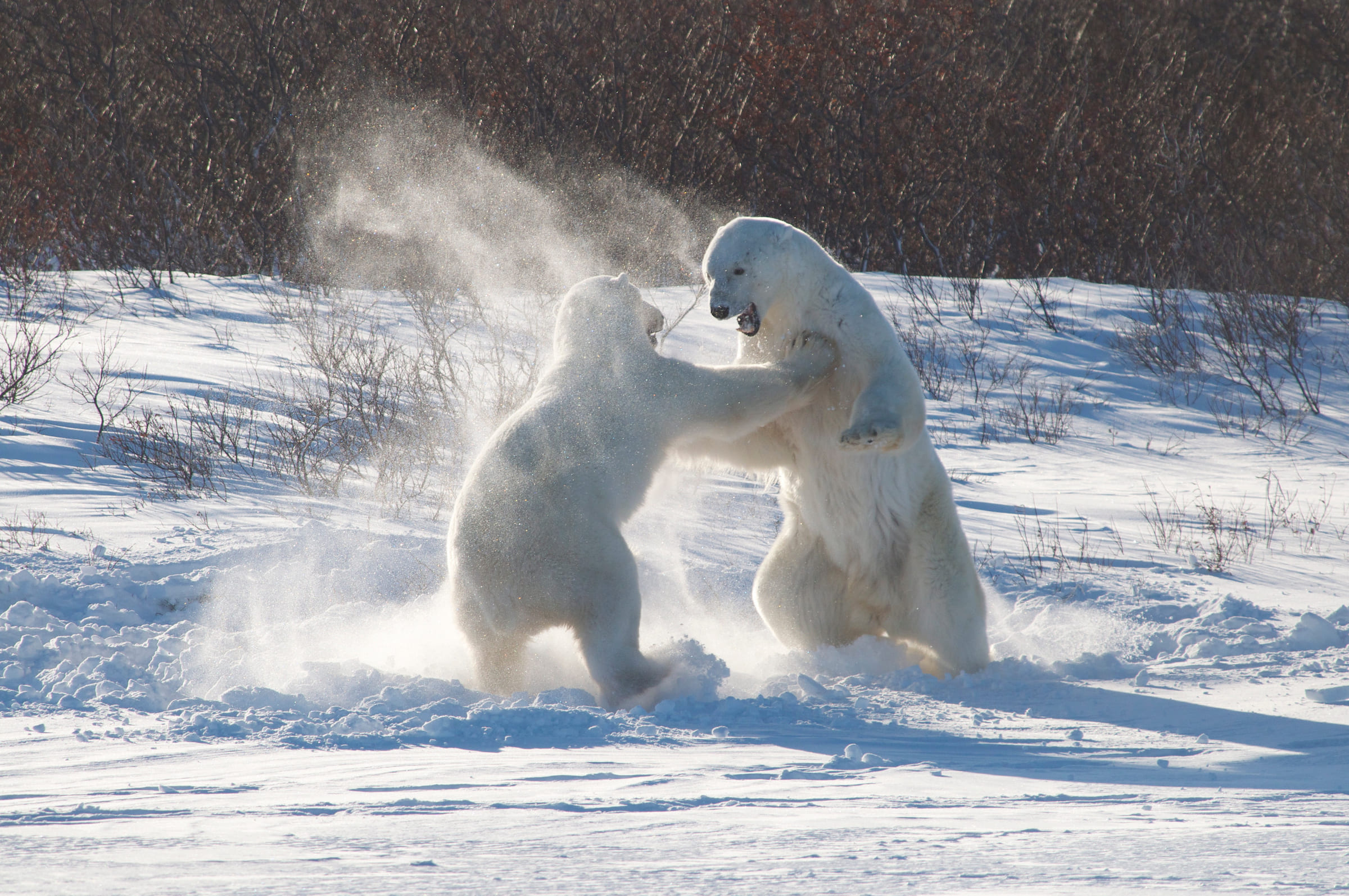
- Sparring males. This is the signature sight of Churchill. Big males rear up on their hind legs and wrestle, mouths open, in slow-motion bouts that can last many minutes. It is practice for the spring breeding season and rarely draws blood.
- Resting and waiting. Much of a bear's day is spent conserving energy: dozing in kelp beds, curled up in the willows, or lying flat on the snow.
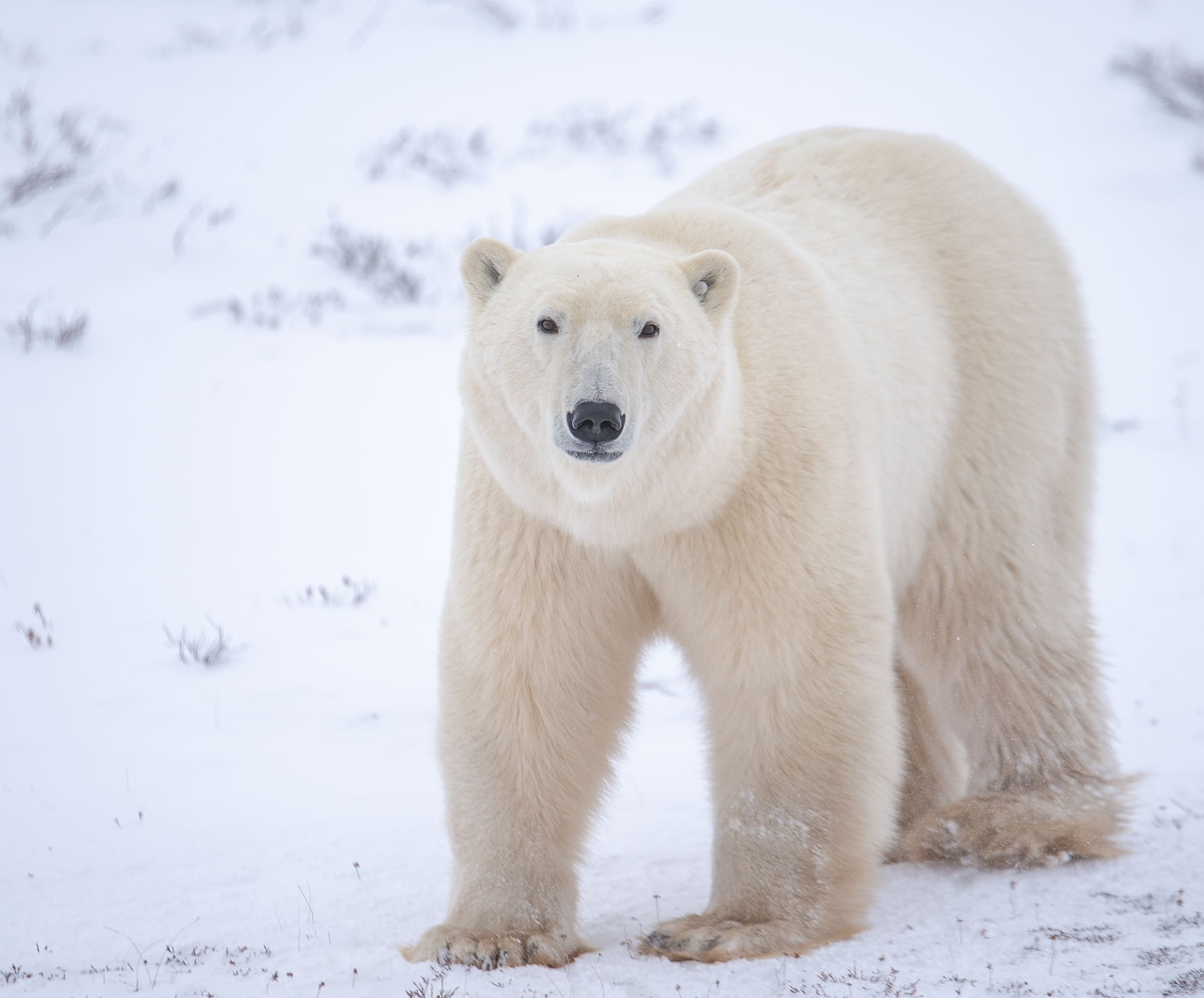
- Curious visitors. Bears sometimes walk right up to the buggy and stand against its side to sniff the air. Seen from the deck above, it is unforgettable.
- Mothers with cubs. Less common than single males, but more likely later in the season.
Beyond the bears
Keep your eyes open for Arctic fox, Arctic hare, willow ptarmigan and snowy owl, all in white winter coats against the snow. On clear nights there is a real chance of northern lights, and the Lodge's distance from town lights gives you the darkest skies.
Photography notes
- Lens range: a 100–400mm zoom (or similar) covers most situations; bears are often 20–100 m away. A wide-angle lens is useful for close approaches and landscapes with the buggy in frame.
- Batteries: cold drains them fast. Carry three or four spares in an inside pocket, close to your body, and rotate them.
- Condensation: when moving from the cold deck into the heated cabin, seal your camera in a zip-lock bag so moisture forms on the bag, not the lens.
- Support: a beanbag on the window frame works better than a tripod in a crowded buggy.
What a polar bear safari in Canada costs
A Tundra Buggy Lodge trip costs roughly $11,800–$14,000 per person all-in, once you add flights to Winnipeg, insurance and tips to the tour price. Here is how it breaks down, anchored on our 6-Day Tundra Buggy Lodge tour.
| Item | Cost per person (USD) | Notes |
|---|---|---|
| Tour price, 2 sharing | From $10,835 | Includes 2 nights Winnipeg, 3 nights at the Lodge, Winnipeg–Churchill charter flights, buggy excursions, guide and most meals |
| Solo supplement | +$230 | Solo price $11,065 |
| Flights to Winnipeg | About $400–$900 (North America); $900–$1,800 (Europe) | Estimate, economy return; not included |
| Travel insurance | About $400–$900 | Trip cancellation and medical cover are required by the operator |
| Tips for guide and driver | About $150–$300 | Estimate; not included |
| Cold-weather gear | $0–$250 | Optional; parkas, snow pants and boots can be rented |
| Estimated total | About $11,800–$14,000 | Two people sharing, flying from North America or Europe |
Prices are from the live tour pages as of October 2026 and can change; check the tour page for current departures.
For comparison, town-based 6–7 day packages generally run from about $3,900 to $8,700 before flights. The 7-Day Photography Lodge tour starts at $12,824. Either way, a polar bear safari in Canada sits at the premium end of wildlife travel.
A summer alternative
Polar bears are also on land around Churchill in July and August, though more spread out and less active than in autumn. The trade-off is a lower price and a very different trip: thousands of beluga whales in the Churchill River estuary, a green tundra, and long days.
Our 7-Day Churchill Beluga Whale and Polar Bear Adventure starts from $6,802.
If you want bears as one highlight among many, the 9-Day Canada Big Five Wildlife Safari pairs Churchill with black bears, moose and bison in Riding Mountain National Park.
The conservation reality
Churchill's bears are in decline, and an honest guide should say so. The most recent aerial survey of the Western Hudson Bay population, flown in 2021, estimated 618 bears. That is down from 842 in 2016 and 949 in 2011, and roughly half the estimate from the late 1980s. Adult females and young bears have fallen the most, which matters because they are the future of the population.
The cause is the ice. Hudson Bay now breaks up earlier in summer and freezes later in autumn, so bears spend longer on land without food. In 2025, after the bay's warmest autumn on record, sea ice solid enough for bears to walk on did not form near Churchill until November 26. Every extra week ashore is another week of fasting.
None of this means the bears are about to vanish next year. Sightings in season remain excellent, and some bears may be shifting between neighboring populations.
But it does mean two things for travelers:
- Go respectfully. Choose operators that hold permits for the Churchill Wildlife Management Area, keep a respectful distance, never feed or bait bears, and support research. Frontiers North, which runs our Lodge tours, provides vehicles and lodge space to Polar Bears International and is converting its buggy fleet to electric.
- Go sooner rather than later. This is one of the clearest places on Earth to see climate change in a single species. Many travelers come home with a deeper understanding of that, which is part of the value of the trip.
Churchill polar bear tours: FAQ
Is a polar bear sighting guaranteed?
No responsible operator will promise one, because these are wild animals. But in peak season, multi-day Tundra Buggy trips see bears on virtually every departure, often many in a single day. Staying at the Lodge, with more hours in bear country, improves your odds significantly.
Churchill or Svalbard: where to see polar bears?
They are very different trips. Churchill is land-based, concentrated and autumnal: you watch bears from a buggy on the tundra, and sightings are highly reliable over a few weeks. Svalbard is a summer expedition cruise, where you search for bears on sea ice and coastlines from a ship. It offers bears in their true hunting habitat and spectacular Arctic scenery, but sightings are more variable and spread over a longer voyage. For the best odds of seeing many bears up close, Churchill wins.
How cold is it?
Average highs are around freezing in October and about -9°C (16°F) in November, with lows near -16°C (3°F). Wind can make it feel 10–15°C colder. The buggies are heated, but you will be stepping onto an open deck, so bring proper layers, insulated boots, a hat, gloves and a face cover.
Can you see the northern lights too?
Yes, but treat them as a bonus. Autumn skies over Hudson Bay are often cloudy, so clear nights are not guaranteed. The Lodge gives you the best chance, with dark skies and a rooftop observation deck.
Is it safe?
Yes, when you follow your guide. On the tundra, you stay inside the buggy or on its fenced deck, high above the ground, and bears cannot reach you. In town, Churchill runs a Polar Bear Alert program to move bears away from homes. Never walk outside town, along the shore, or anywhere after dark without a guide.
Ready to start planning? See dates and availability for the Tundra Buggy Lodge tour, or browse all our bear watching tours.


.jpg)