Swim with Orcas in Norway: Season, Cost & What It's Like
· FaunaExplore

Photo: Valhalla Expedition
There’s one place on Earth where you can reliably slip into the sea beside wild orcas: the fjords north of Tromsø, around Skjervøy and Kvænangen. Each winter, roughly November to January, a vast shoal of herring settles into this sheltered water, and the orcas follow.
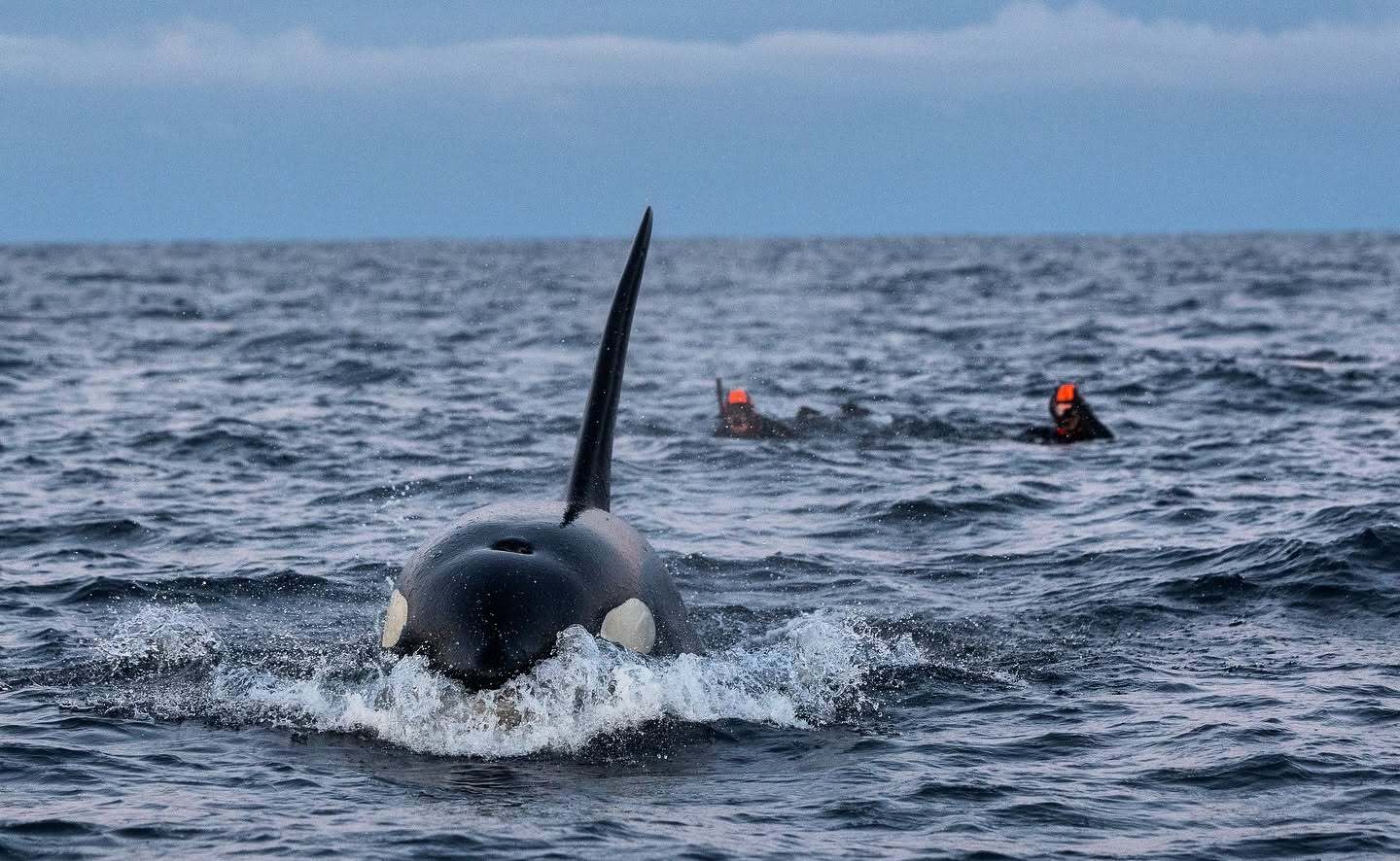
To swim with orcas in Norway, you float at the surface in a thick cold-water suit, in small groups, for 20 to 40 minutes at a time. Spotting them from the boat in season is very likely, while getting in the water with them depends on weather, light and the herring.
In this guide, we cover the best weeks to go, what the water is really like, the rules that matter, and what a trip costs, so you can decide whether it’s for you.
Why here: the herring that brings Norway's orcas
Every winter, Norwegian spring-spawning herring, one of the largest fish stocks on the planet, crowd into the deep, sheltered fjords of northern Troms to overwinter. Orcas follow them in their hundreds, along with humpback whales, fin whales and flocks of gulls and sea eagles.
The orcas here are herring specialists. They work as a family to herd fish into a tight ball near the surface, slap it with their tails to stun them, then pick them off one by one. That feeding is why a snorkeller can be in the right place at all: the action happens in the top few metres of calm fjord water rather than far out at sea.
The catch is that the herring choose where to winter, not the tour operators. For years the hotspot was further south, in Tysfjord and around Lofoten. Since about 2017, it has been the Kvænangen fjords near Skjervøy, which makes Skjervøy orcas the reliable headline today. It may not stay that way, and good operators adapt their base to wherever the fish settle.

Photo: Valhalla Expedition
When to swim with orcas in Norway: season and daylight
The orcas arrive with the herring in late October, and the season typically fades by late January or early February. Daylight is the real constraint. In the Tromsø region the sun doesn't rise from roughly late November to mid-January, and the dark period lasts slightly longer at Skjervøy. Boats still go out in the blue midday twilight, but you get fewer hours to work with.
| Period | Light | Whales and herring | Our verdict |
|---|---|---|---|
| Late October | Short but real daylight | Herring arriving, orcas building up | Good gamble for early bookers |
| November, weeks 1–2 | A few hours of low sun | Orcas usually settled, big herring concentrations | Best all-round window for swimming |
| November, week 3 | Light fading fast | Strong | Very good |
| Late November | Polar night begins (~27 Nov) | Strong | Good, with shorter time in the water |
| December | No sunrise; blue twilight around midday | Often peak whale numbers | Superb for whales and aurora; swims limited to twilight hours |
| Early to mid-January | Sun returns around mid-month | Usually still present | Good, slightly more variable |
| Late January | Light returning steadily | Herring begin to leave | Last chance of the season |
Patterns vary year to year with the herring; treat this as a guide, not a guarantee.
Snorkeling with orcas: what being in the water is really like
The day starts slowly. You wait for the light, check the wind, and head out by RIB (rigid inflatable boat) to scan for blows, diving birds and fishing boats. When the skipper finds a pod feeding calmly, the boat moves ahead of the animals' path and cuts the engine. You then slip over the side quietly in a small group, never all at once, and float at the surface with a mask and snorkel.
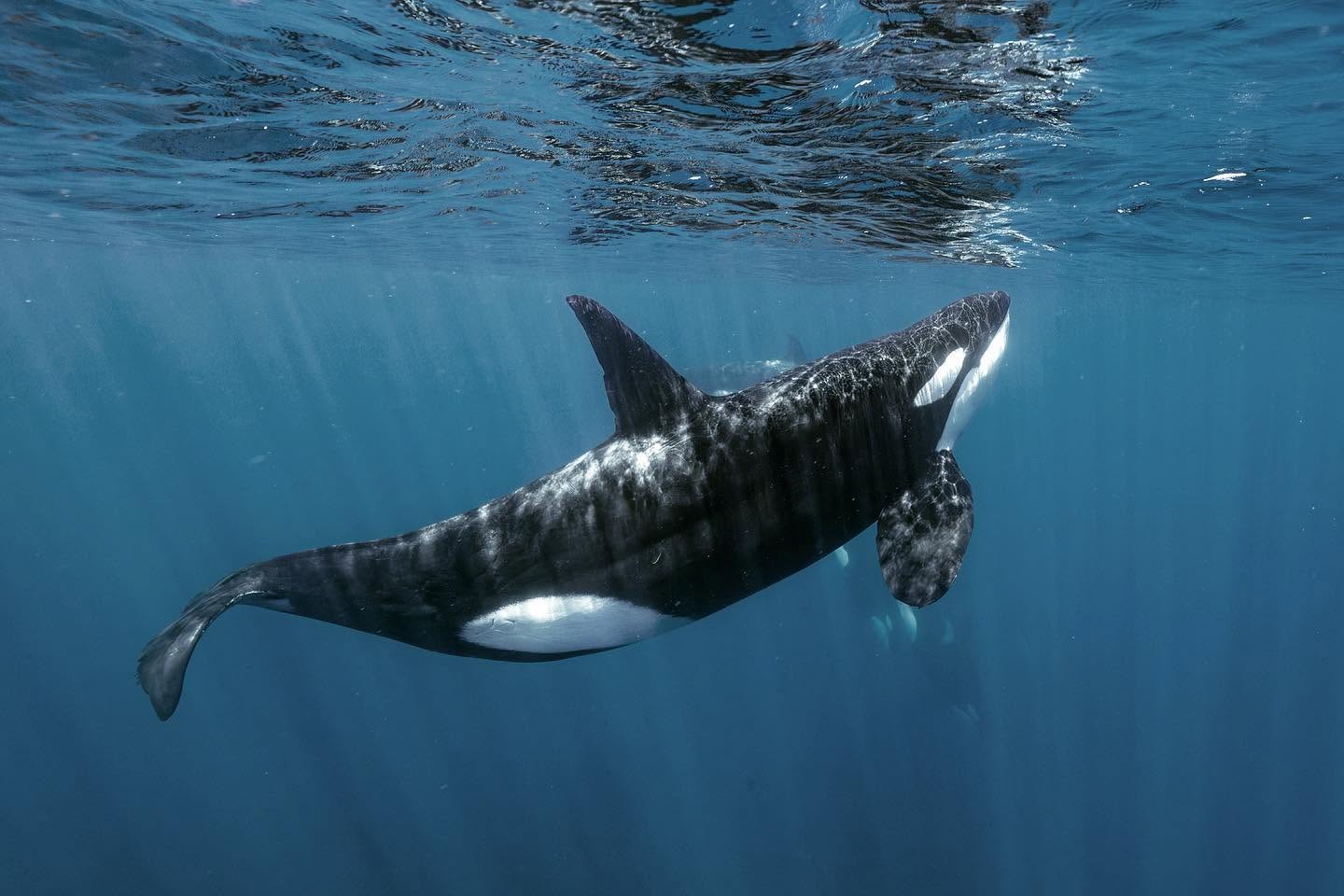
Then you wait. You don't swim after orcas, and you couldn't keep up if you tried. They come past you or they don't. Sometimes a pod drifts by at ten metres. Sometimes a curious young animal circles once and moves on. On the best days the whole family works a herring ball beneath you, the water fills with silver scales, and you can hear the clicks and calls through your hood. Bear in mind that no orca has any interest in you. They are fast, focused hunters, and to them you are furniture.
Each session lasts roughly 20 to 40 minutes, and there are usually several sessions a day when conditions allow. Between them, you're back on the boat in a dry robe with hot soup. Visibility can reach 10 to 20 metres in clear conditions and drops right when a herring ball is densest. That murky moment is often when the most is happening.
Rules of the encounter, and why your operator matters here more than anywhere
Norway's whale-safari regulation is short. It bans running whale trips in a way that disturbs the animals, and it keeps boats and swimmers well away from active fishing vessels. It sets no legal minimum distance between people and whales.
Day-to-day conduct relies on voluntary guidelines drawn up by researchers and the regional tourism board. These cover slow approaches, idling near the animals, a cap of three boats around one group, and no more than 30 minutes per encounter.
Many operators follow them, but some don't. In recent seasons, the fjords around Skjervøy have seen crowding by fast boats, and some have dropped snorkellers right into feeding pods. Norwegian authorities and parts of the tourism industry are now pushing for binding rules, including proposals to license operators and to restrict commercial snorkelling with whales. This means that the rules may change, so make sure to check before you book.
The guidelines for your trip should therefore come from your operator. Our operator partner, Valhalla Expedition, works on a no-chase, no-touch basis. The boat cuts its engine before anyone enters the water, the skipper decides from the animals' behaviour whether a swim happens at all, and the orcas stay free to leave at any time. A day with fewer swims and calm, undisturbed whales is a good day.
What the law says: Whale-safari boats must stay at least 370 m from vessels actively fishing, and swimming, diving or paddling within 740 m of a fishing vessel or fixed gear is banned. Disturbing whales in their habitat is prohibited. Read the law on this page (in Norwegian).
What the voluntary guidelines say: Boats should keep to three per group and 30 minutes per encounter, slow to under 5 knots within 300 m and idle from 50 m. The guidelines also advise against swimming or diving with whales. Check the guidelines here.
On 16 October 2026, the Directorate of Fisheries said whale safaris in Nord-Troms and Vest-Finnmark are increasingly causing problems for whales and fishers. Four major Tromsø-region tourism players (Brim Explorer, Destination Tromsø, Best Arctic and Visit Tromsø-Region) are asking the government for licensing, speed limits, a cap on boats per whale group and a ban on commercial snorkelling with whales. The ministry says it is working on clearer rules, but the new season started without them.

Photo: Valhalla Expedition
Orca safari in Norway: boat-only or snorkel trip?
You don't have to get in the water to have a great trip. On both of our expeditions, snorkelling is optional. Anyone who'd rather stay on the RIB watches the same encounters from the surface, often with a better view of the whole pod.
The real choice is how much time you give the fjords:
- Pick the shorter expedition if snorkelling is the main goal and your dates are tight. The 4-Day Arctic Orca Snorkeling Expedition in Reinfjord is built around in-water sessions from a remote camp. You get several days on the water, which is enough to absorb one weather day.
- Pick the week if you want the best overall odds, more humpback time and more nights under the aurora, or if your travelling companion would rather watch than swim. The 7-Day Orca & Humpback Whale Expedition in Seglvik gives you six days at sea, and swimming is available for those who pass the training session.
Single half-day snorkel trips from Skjervøy also exist and cost less. They give you one shot, though, and one bad-weather morning means no swim at all.

Photo: Valhalla Expedition
Humpbacks and the aurora: a great trip even on a no-swim day
Orcas are the headline, but they share the fjords. Humpback whales come for the same herring. Watching a humpback burst through the surface with its mouth full of fish, a few hundred metres from the boat, is a sight many guests rank above everything else. White-tailed sea eagles circle the fishing boats, and seals and white-sided dolphins turn up too.
Then there are the nights. The Tromsø region sits under the auroral oval, and long, dark nights in November and December give you many hours of aurora-watching. A clear night is never guaranteed, but on a week-long trip your odds of seeing the northern lights at least once are good. From a remote fjord camp with no city lights, you may only need to step outside.

Photo: Valhalla Expedition
Fitness, gear and the cold: the honest version
You don't need to be a diver, but you do need to be a confident open-water swimmer, relaxed with mask and snorkel, and able to climb back onto a RIB with a hand from the crew. Expect a training session in calm water before your first orca swim. The operator can decide you're better off watching from the boat, and that is a safety call, not a judgement.
The cold is real but manageable. The water is around 4–7 °C, and air temperatures typically range from about −8 °C to +4 °C, with wind chill at speed. You'll wear a thick cold-water suit with hood, gloves and boots over thermal layers, and a dry robe on the boat between swims. The supplied kit covers the water. Your job is everything underneath and around it: merino or synthetic base layers (no cotton), a warm hat, waterproof outer layers and good gloves for the boat. Keep in mind that the minimum age is 16.
Cost and logistics
A Norwegian orca trip takes a little more planning than most wildlife holidays, because getting to the fjords is part of the journey and a few costs sit outside the tour price.
Getting there
Fly into Tromsø (TOS), then take the public express ferry north to Skjervøy (about three hours). From there, a private boat takes you to Reinfjord, or a second short ferry runs to Seglvik. We strongly recommend one or two nights in Tromsø before you head north, because ferries and flights can be delayed in winter.
What it costs with us
| 4-Day Reinfjord | 7-Day Seglvik | |
|---|---|---|
| Length | 5 days | 8 days |
| From (per person) | $4,026 | $5,635 |
| Included | Accommodation, breakfast, snacks, tea time, dinner, sauna and jacuzzi, equipment, boat transfer Skjervøy–Reinfjord | Accommodation, breakfast, snacks, tea time, dinner, sauna and jacuzzi, equipment |
| Not included | Flights, Tromsø–Skjervøy ferry, travel insurance | Flights, transfers, travel insurance |
Prices vary by departure date; confirm at booking.
Make sure to budget separately for:
- International flights
- One or two hotel nights in Tromsø
- Ferry ride (roughly $50–60 each way)
- Drinks
- Travel insurance that covers snorkelling and trip interruption
Why it costs what it does
Every day involves a skipper, an in-water guide, specialist cold-water kit, fuel for long days on the fjord, and a remote camp supplied by boat in the Arctic winter. Small groups are the point. For comparison, multi-day liveaboards elsewhere in the region typically run around $7,700–10,800 for six or seven nights.
Departures run from mid-October to late January. Dates are on request, and the popular weeks sell out early.
FAQ
Is swimming with killer whales dangerous?
There is no record of a wild orca killing a person, and Norway's herring-eating orcas show no interest in snorkellers. The real risks are cold water, weather and boat traffic. They are managed through good kit, training, an experienced skipper and following the guide's instructions every time.
Will I definitely swim with orcas?
No, and anyone who promises it is overselling. Seeing orcas from the boat in season is very likely. Getting in the water near them depends on wind, light and how the animals are behaving that day. More days on the water is the single best way to improve your chances.
Do I need diving experience?
No certificate is needed. You do need to be a confident swimmer who is comfortable snorkelling in open water. The training session before your first orca swim gets you used to the suit and the cold.
How cold is the water?
Around 4–7 °C. With a thick suit, hood, gloves and boots, most people are comfortable for a 20–40 minute session. Your hands and face feel it first.
Can I see the northern lights on the same trip?
Very possibly. Orca season falls in the darkest months, the region sits under the auroral oval, and remote camps have almost no light pollution. Clear skies are the only thing you need luck with.
Ready to go? Explore our orca expeditions, or go straight to the 4-Day Arctic Orca Snorkeling Expedition in Reinfjord or the 7-Day Orca & Humpback Whale Expedition in Seglvik.