Peru Wildlife: The Complete Amazon Guide
· FaunaExplore

Peru wildlife is best experienced in the Amazon, and Peru offers the most accessible slice of it. Three areas do most of the work. Tambopata, a short flight from Lima or Cusco to Puerto Maldonado, is the place for macaw clay licks and giant otters. Manu National Park, reached overland from Cusco, is the deep, pristine forest option. The northern Amazon around Iquitos, including the Tamshiyacu-Tahuayo reserve where our Amazon tours run, is best for pink river dolphins and monkeys.
Plan on four days minimum, expect monkeys and birds on every trip, but treat jaguars as a bonus, not a promise.
This guide covers what you can realistically see, when to go, how the regions compare, what a trip costs and how Peru stacks up against Brazil.
The signature sights of Peru's Amazon
Five sights define a Peru wildlife trip, and each has its own best place to see it.
The Tambopata macaw clay lick
This is the sight that puts Peru on wildlife itineraries. A clay lick (collpa in Peru) is an exposed riverbank of mineral-rich clay. Parrots and macaws gather to eat it, most likely for sodium and to buffer toxins in their diet. Tambopata National Reserve holds the most famous licks on Earth. Colpa Colorado is the largest known macaw clay lick, and Chuncho is the most visited.
A morning at the lick starts before sunrise. You sit in a hide or on a riverbank platform, well back from the clay. Parrots arrive first, calling from the treetops. If conditions are right, they drop onto the bank in waves, followed by red-and-green, scarlet and blue-and-yellow macaws. On a good day you'll see hundreds of parrots and perhaps 20 to 40 large macaws at once.
However, birds rarely come down in rain, fog or strong wind, so allow at least two dawn attempts. Also, activity is seasonal (see the table below). Research at the Tambopata Research Center found large macaws are most active at the licks from September to January and least active from April to June.
Pink river dolphins
If you're wondering where to see pink river dolphins in Peru, the answer is the north, not Tambopata or Manu. The Amazon river dolphin is a reliable sight on the rivers around Iquitos, in the Pacaya-Samiria National Reserve and along the Tahuayo River, where our Amazon tours are based.
Most visitors see them from a small boat, often alongside the smaller grey tucuxi dolphin. Confluences, where two rivers meet, are the classic spots. Pink dolphins are on the species list of every Tahuayo wildlife trip we offer, starting with the 4-Day Amazon Peru Rainforest Wildlife Experience.
You'll be on the water in either season. High water (roughly December to May) lets boats slip into the flooded forest. Low water (roughly June to November) concentrates fish in the main channels, which concentrates the dolphins too.

Photo: Amazonia Expeditions
Monkeys
You’re almost certain to see monkeys. The Tamshiyacu-Tahuayo reserve near Iquitos is one of the richest primate areas in the Amazon, with at least 16 species recorded.
The species on our Tahuayo itineraries include:
- Pygmy marmoset: the world's smallest monkey, small enough to fit in your hand, often found feeding on tree sap.
- Squirrel monkey: travels in big, noisy troops and is often spotted from the boat.
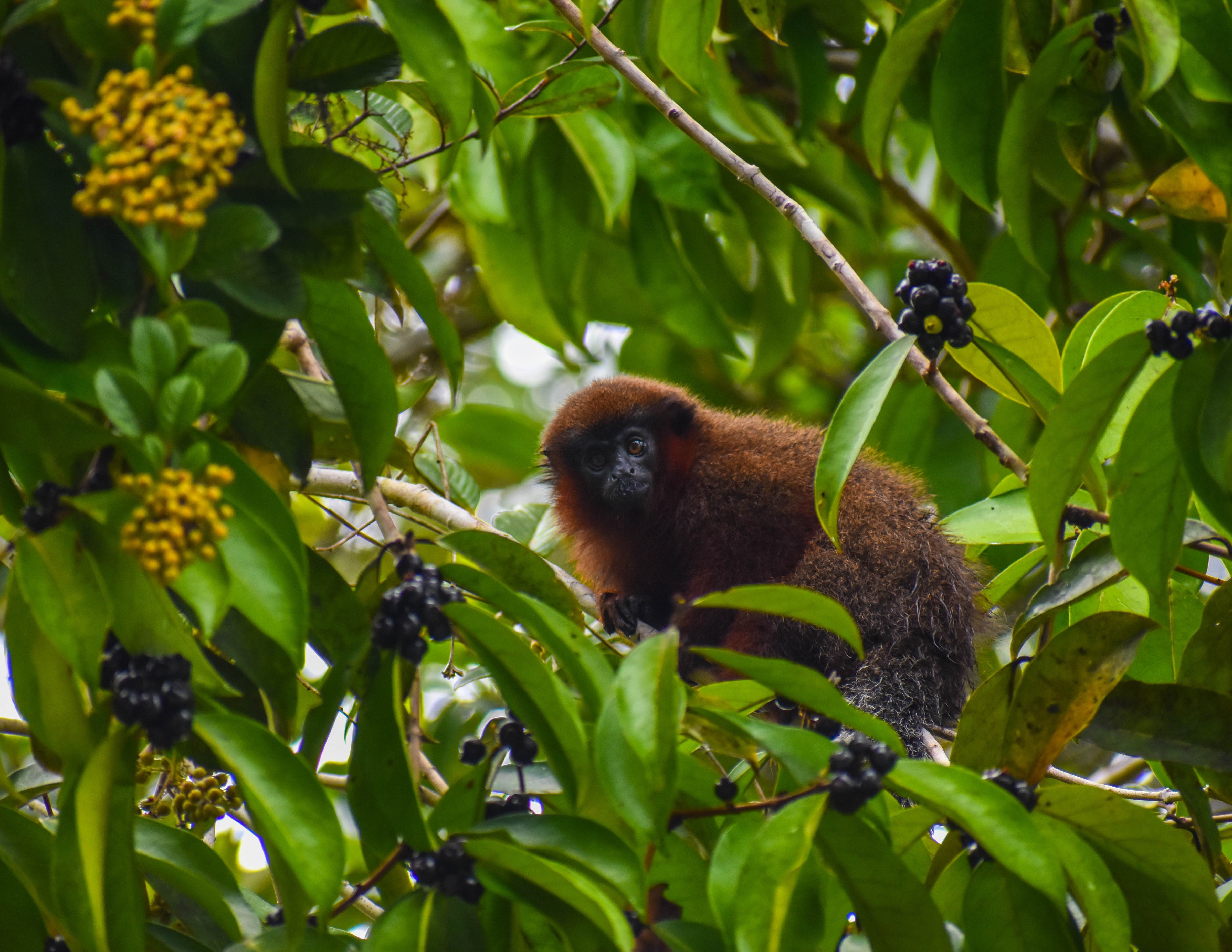
- Titi monkey: small, round-headed and more often heard than seen. Pairs duet at dawn.
- Saki monkey: shaggy and shy, with a long bushy tail.
- Red uakari: the bald, red-faced monkey the reserve was created to protect. This subspecies lives only in Peru, and seeing one takes time and luck.
Further south, Tambopata holds at least eight species. Brown capuchins, saddleback tamarins, red howlers and spider monkeys join the squirrel and titi monkeys, and most visitors see three to five species on a four-night stay.

Photo: Amazonia Expeditions
Giant otters
Giant otters can reach 1.8 metres long and live in family groups on quiet oxbow lakes (cochas). They are one of the most exciting animals to watch in South America, and Peru is one of their strongholds.
In the south, Lake Sandoval is about an hour by boat from Puerto Maldonado, while Cocha Salvador and Cocha Otorongo in Manu's reserved zone have had otter families under study since 1990. In the north, giant otters are on the species list for our Tahuayo expeditions.
You'll watch from a catamaran or an observation tower, at a set distance, because long-term monitoring showed heavy tourism hurt breeding success at some lakes. Sightings aren't guaranteed, but a family fishing in morning light is one of the best wildlife moments in the Amazon.
Poison frogs
Poison frogs are Peru's most underrated wildlife, and the place to see them is not the classic lodges but the forests of the San Martín region around Tarapoto. This is where our Peru Poison Frog Photography Tour runs: nine days searching Alto Shilcayo, Pongo de Caynarachi, Yurimaguas and Chazuta for species such as Ranitomeya fantastica, R. imitator, R. summersi and Ameerega bassleri. Several are found only in Peru.
The tour is led by Jack Small Photo Tours with local field guide Angel Chujutalli, and it pairs night hikes with photography coaching.
Bonus sightings: tapir, caiman and the jaguar question
Other animals turn up on many trips: black and spectacled caiman, capybara, hoatzin and tapir at mammal licks after dark. Jaguars live in both Manu and Tambopata, and they're sometimes seen resting on riverbanks in the dry season. But even on a week-long stay, a sighting is a stroke of luck, not a plan. If jaguars are the goal, Brazil is the better bet (see the FAQ).
Best time to see Peru wildlife
The Amazon is a year-round destination, but the seasons change the trip.
In the south (Tambopata and Manu), the dry season runs roughly May to October, with firmer trails, fewer mosquitoes and wildlife concentrated around water. The wet season, roughly November to April, brings lush forest, afternoon downpours and muddier walks.
In the north (Iquitos and Pacaya-Samiria), what matters is the water level rather than the rainfall.
| Months | Tambopata & Manu (south) | Macaw clay licks | Iquitos & Pacaya-Samiria (north) | Verdict |
|---|---|---|---|---|
| Jan–Mar | Wettest months; heavy rain, muddy trails | Good macaw activity; rain can cancel mornings | High water; boats explore flooded forest | Lush and quiet; pack for rain |
| Apr–Jun | Rains ease; dry season starts in May | Quietest months for large macaws | Water peaks, then starts to drop | Good for Manu trails; weaker for licks |
| Jul–Aug | Driest, coolest months; occasional cold fronts (friajes) | Activity building; parrots active | Low water; trails open, dolphins in main channels | Peak season; book lodges early |
| Sep–Oct | Dry, hot; first storms by October | Macaw activity picks up strongly | Low water continues | Best all-round window |
| Nov–Dec | Rains return | Peak macaw activity | Water rising; high water from December | Best for clay licks if you accept rain |
Patterns vary year to year, and clay lick activity depends on the weather on the day as much as the month. If the macaw clay lick is your top priority, aim for September to December and allow at least two dawns at the lick.
Manu vs Tambopata: which is right for you?
Tambopata is the easier, more comfortable choice and the better one for clay licks. Manu is the bigger adventure, with wilder forest and a better shot at large mammals, but it takes more time. Most first-time visitors are happiest in Tambopata.
Travellers who have done the Amazon before, or who want the full journey from the Andes down into the lowlands, tend to pick Manu.
| Tambopata | Manu National Park | |
|---|---|---|
| Getting there | Fly to Puerto Maldonado (about 30 minutes from Cusco), then road and boat to the lodge | Long drive from Cusco over the Andes (around 8–12 hours), then a full day by boat; limited light-aircraft flights |
| Time needed | 3–5 nights; 5+ for the remote Colpa Colorado | 5–8 days for the reserved zone; 3–4 days covers only the cultural zone |
| Comfort | Wide choice, from simple ecolodges to luxury lodges with private bathrooms | Simpler lodges and some shared bathrooms in the reserved zone |
| Best for | Macaw clay licks, giant otters at Lake Sandoval, short trips | Pristine forest, the cloud forest descent, giant otters at Cocha Salvador, larger mammals |
| Crowds | Busier near Puerto Maldonado; quiet deeper in the reserve | Very low; access to the reserved zone is limited to licensed operators |
Manu National Park wildlife and the cloud forest
Manu is a UNESCO World Heritage Site and one of the most biodiverse protected areas on the planet. Part of its magic is the journey in. The road from Cusco drops from high Andean grassland through cloud forest before it reaches the lowland rainforest. In the cloud forest, early-morning stops at a lek let you watch male Andean cocks-of-the-rock, Peru's national bird, displaying in brilliant orange.
In the lowlands, Manu's reserved zone is the draw. Only licensed operators may take visitors in, and the forest shows it: spider monkeys, giant otters on Cocha Salvador and Cocha Otorongo, tapirs and white-lipped peccaries. You might see a jaguar on the riverbanks in the dry season, though most visitors don't.
The northern alternative: Tamshiyacu-Tahuayo near Iquitos
Our Amazon tours run in a third area that many guides overlook. The Tamshiyacu-Tahuayo reserve is a 4,200 km² community-managed reserve south-east of Iquitos, protected for its primates since 1991. Our operator partner, Amazonia Expeditions, is a local Peruvian company with more than 45 years of experience, and it runs lodges on the Tahuayo River.
Trips start with a speedboat ride of up to four hours from Iquitos to Tahuayo Lodge, and longer itineraries add nights at the more remote Amazon Research Center. Every trip is private to your group, with a private guide, a canopy experience and flexible start dates.
Tahuayo is the strongest of the three areas for pink dolphins and monkeys, and it suits families too, with reduced rates for teens and children. It has no macaw clay licks to rival Tambopata's, so choose the south if those are your priority.
Planning Peruvian Amazon tours
Most Peruvian Amazon tours follow the same pattern: a domestic flight from Lima, a boat ride to a lodge and early starts with a guide. Knowing the logistics ahead of time makes the trip far easier.
Getting there from Lima
Nearly every trip starts with an international flight into Lima. From there:
- Tambopata: fly direct to Puerto Maldonado, or via Cusco if you are pairing the trip with Machu Picchu. The Cusco leg is roughly 30 minutes.
- Manu: fly to Cusco, then go overland with your operator. Spend a night or two in Cusco first; at 3,400 metres it needs some acclimatisation.
- Iquitos and Pacaya-Samiria: fly to Iquitos, the largest city in the world that can't be reached by road. Our Tahuayo trips include the transfer and a speedboat ride of up to four hours to the lodge. River cruises into Pacaya-Samiria usually start from the nearby port of Nauta.
- Tarapoto (poison frogs): a short domestic flight from Lima. On our frog tour, this flight isn't included and costs about $200 return.
How a lodge-based trip works
Nearly all of these trips are lodge-based. You stay in one or two lodges and head out each day with a naturalist guide on foot, by boat or up a canopy tower.
A typical day starts around 4:30 or 5:00 am for the clay lick or the dawn chorus. You rest through the hot middle of the day, walk again in the late afternoon and often head out after dark for frogs, insects and caiman. Meals, guiding and transfers from the airport are usually included.

Photo: Amazonia Expeditions
Heat, humidity and fitness
The Amazon is hot and humid year-round, often 30°C or more by day with humidity near 90%. Trails are mostly flat, but they can be muddy, rooty and slippery, and lodges usually lend rubber boots. You don't need to be an athlete, but you do need to be comfortable walking two to four hours a day in sticky heat and getting up before dawn. Pack quick-dry long sleeves, a good insect repellent, a head torch and binoculars.
Malaria is present in the lowland Amazon, including Iquitos and Puerto Maldonado, so speak to a travel clinic about prevention well before you go. Yellow fever is covered in the FAQ below.
How much does a Peru wildlife trip cost?
Our Peru tours start from $895 per person. The Tahuayo trips include lodging, buffet meals, a private guide, a canopy experience, boat and airport transfers, and all fees and taxes. International flights, insurance, drinks, tips and laundry are extra.
The frog tour includes guiding, lodging, meals, in-country transport and entry fees, but not the return flight to Tarapoto (about $200).
| Tour | Length | From (USD pp) |
|---|---|---|
| 4-Day Amazon Peru Rainforest Wildlife Experience | 4 days | $895 for 2 travellers; $995 solo |
| 6-Day Peruvian Amazon Wildlife & Research Expedition | 6 days | $1,295 for 2; $1,395 solo |
| 8-Day Peruvian Amazon Wildlife and Research Adventure | 8 days | $1,695 for 2; $1,795 solo |
| 10-Day Peruvian Amazon Wildlife and Research Expedition | 10 days | $2,095 for 2; $2,195 solo |
| 10-Day Peruvian Amazon Birdwatching Expedition | 10 days | $2,195 |
| 12-Day Peruvian Amazon Wildlife and Research Expedition | 12 days | $2,495 for 2; $2,595 solo |
| Peru Poison Frog Photography Tour | 9 days | $3,750 |
For Tambopata and Manu, where we don't list tours yet, typical published rates make useful planning estimates. Expect roughly $900–2,000 per person for a 3–4 night Tambopata lodge package, and a similar range for 5–8 days in Manu's reserved zone.
On top of that, budget for:
- Domestic flights from Lima or Cusco: roughly $100–300 each way (estimate).
- Tips for guides and lodge staff: a common guideline is around $10–20 per guest per day (estimate).
- Travel insurance with medical evacuation cover, which is essential this far from a hospital.
What drives the price? Mostly remoteness and guiding. Fuel and food travel upriver by boat, and the further out the lodge, the closer you are to quiet forest and rarer wildlife. Private guiding and specialist experts cost more, but they are what turn a jungle stay into a wildlife trip.
Peru wildlife FAQ
Is the Amazon safe to visit?
Yes, on an organised trip with a licensed operator. The real risks are health-related rather than wild animals: heat, insect-borne diseases, slips on wet trails and the distance from a hospital. Follow your guide's instructions near water and on night walks, carry insurance with evacuation cover and check your government's travel advice before you go. Strikes and road blockades occasionally disrupt travel in Peru, so build a spare day into tight itineraries.
Should I go to Peru or Brazil for the Amazon?
It depends on what you most want to see. Choose Peru for rainforest immersion and birds: clay licks with hundreds of parrots, monkeys every day, giant otters and the cloud forest on the way to Manu. Choose Brazil's Pantanal if your priority is jaguars and easily visible mammals. The Pantanal is an open wetland rather than a rainforest, and jaguar sightings along its rivers are far more reliable than anywhere in the Amazon.
A good starting point is the Northern Pantanal Jaguar Safari and Wildlife Adventure, six days from $4,098. You'll find the rest on our Jaguar Safari and Brazil pages. Many travellers end up doing both countries.
Do I need a yellow fever vaccination for Peru?
Peru doesn't require proof of yellow fever vaccination to enter the country. However, vaccination is recommended for travellers aged nine months and over visiting the Amazon regions below 2,300 metres, which include Tambopata, Manu, Iquitos and Tarapoto.
Get it at least 10 days before you travel and carry your certificate. Some onward destinations, such as Bolivia, may ask for proof if you arrive from Peru. The vaccine isn't suitable for everyone, including some travellers over 60, so take advice from a travel clinic.
How many days do I need in the Peruvian Amazon?
Four days is the practical minimum. Our 4-Day Amazon Peru Rainforest Wildlife Experience gives you two full days around Tahuayo Lodge, and four days in Tambopata gives you two dawns at the clay licks. Six to eight days is better for rarer species such as the red uakari: our longer Tahuayo trips add nights at the remote Amazon Research Center.
Manu's reserved zone needs five to eight days from Cusco. For poison frogs in the San Martín region, our tour runs nine days.
Plan your Peru wildlife trip
Ready to explore the Peruvian Amazon? Start with the 4-Day Amazon Peru Rainforest Wildlife Experience near Iquitos, or go deeper with the 12-Day Peruvian Amazon Wildlife and Research Expedition.
Birders should look at the 10-Day Peruvian Amazon Birdwatching Expedition, and photographers at the Peru Poison Frog Photography Tour.
If you want to discover more of this beautiful country, see all our Peru tours.
.jpg)


 .jpg)